

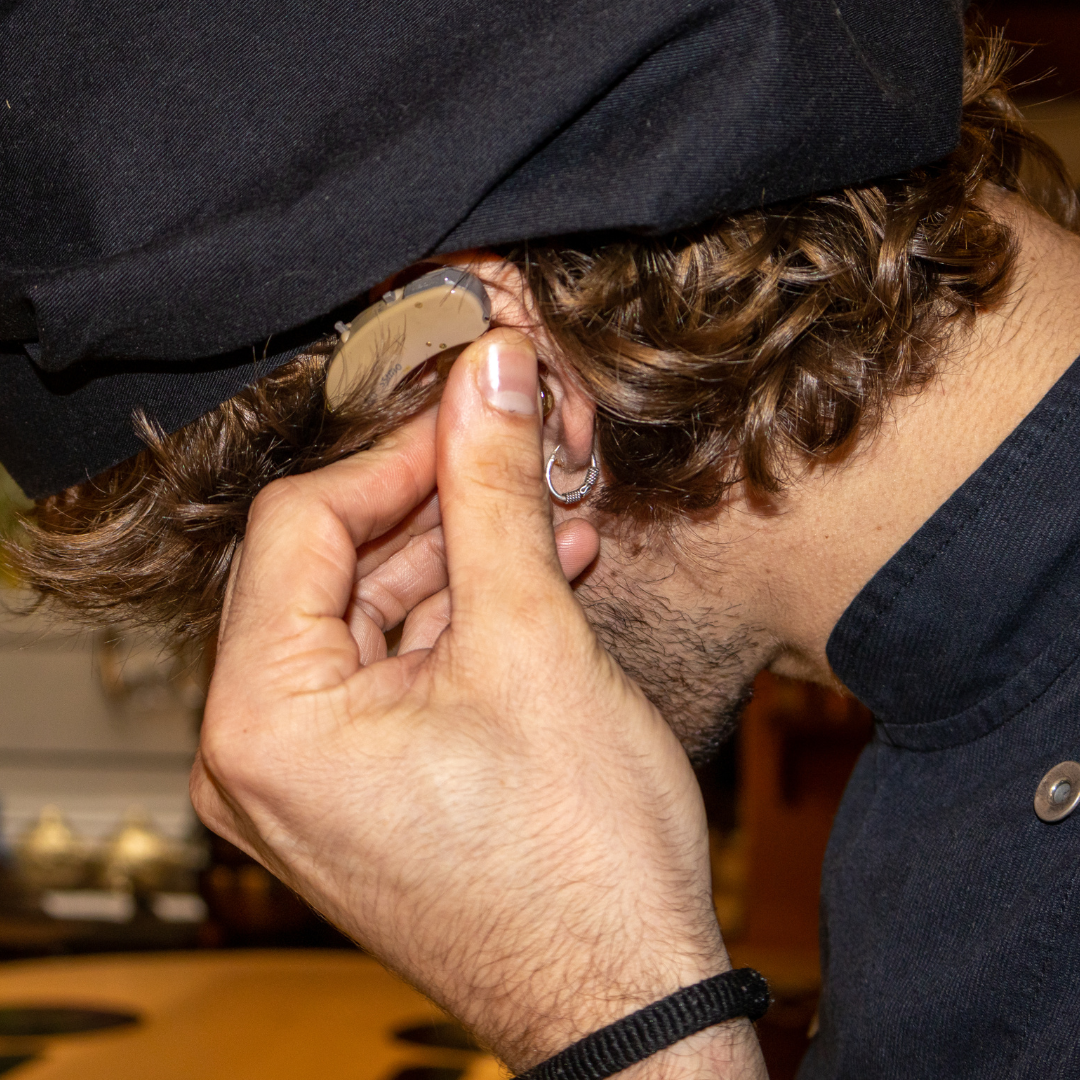
Following dinner conversations becomes challenging when high ambient noise interferes with your focus and hearing. Our specialists can evaluate hearing under both calm and noisy listening conditions to establish why noisy rooms present such difficulty. Once we determine the cause of difficult hearing, we can help you find personalized solutions.
Why Everyday Hearing Fails in Busy, Noisy Restaurants
Quiet rooms provide a favorable signal-to-noise ratio, meaning a speaker’s voice is much clearer than the sounds around it. Modern restaurant environments create the complete opposite listening environment. Background voices, loud music, service clatter, and wall reflections collide with spoken words, demanding heightened cognitive processing to isolate individual speech.
This problem can occur with high-frequency hearing loss, auditory-processing difficulty, or age- and noise-related changes. Visual limitations from low lighting, cognitive fatigue, and sitting farther away from conversational partners amplify speech degradation. It is common to display normal baseline audibility on conventional hearing tests while failing comprehensive speech-in-noise testing. Disproportionate difficulty in restaurants justifies professional clinical assessment even if your everyday home hearing appears intact.
How Audiologists Identify High-Frequency Hearing Loss
We initiate evaluation by exploring challenging acoustic environments, acoustic trauma history, subjective tinnitus, prescription drug profiles, and unilateral ear changes.
Diagnostic pure-tone audiometry establishes the softest auditory thresholds you can perceive across standardized frequencies via air and bone conduction pathways. High-frequency loss often creates an audiogram pattern in which thresholds become poorer as pitches rise. Supplementary assessments routinely include diagnostic tympanometry to analyze middle-ear status alongside word-recognition testing to determine speech clarity.
Standard quiet test booths fail to simulate real-world restaurant noise, making speech-in-noise testing a crucial clinical tool. This procedure gauges speech-discrimination accuracy while competing multi-source noise becomes incrementally louder. Together, these audiological findings indicate whether the issue involves sound audibility, speech intelligibility, noise-processing dysfunction, or multiple compounding factors.
Adult Auditory Processing Disorders and Speech Perception
A central auditory processing disorder disrupts the neurological transmission and cognitive interpretation of sound waves. The physical ear mechanisms may capture tones correctly, but the central brain pathways struggle to filter competing inputs, parse similar consonants, or interpret rapid speech. We first rule out peripheral sensorineural deficits before deciding whether a dedicated auditory-processing test protocol or specialist referral is indicated.
Behavioral Strategies for Hearing Clearly in Loud Venues
Minor environmental adjustments can boost speech acoustic signals and supply critical visual lip-reading cues. Before leaving home, identify quieter dining venues or plan to eat during less crowded service times. Restaurants featuring plush booths, wall acoustic panels, heavy drapery, carpeting, and sound-dampening materials provide superior listening compared to open rooms with reflective surfaces.
At the restaurant:
- Ask for seating positioned far away from open kitchens, noisy bar areas, ceiling speakers, and large parties.
- Situate yourself with a structural wall behind you to minimize distracting ambient noise from behind.
- Face your conversation partners in good lighting.
- Sit as close to the speaker as comfort permits to preserve speech volume and clarity.
- Turn your better-hearing ear toward the specific speaker you want to hear most clearly.
- Request that companions rephrase misunderstandings using different words rather than repeating the same sentence.
- Confirm important details rather than pretending to understand.
- Take a brief listening break when fatigue begins to build.
- Ask companions to speak clearly at a natural pace.
- Shouting creates acoustic distortion that actively compromises speech understanding rather than helping.
Assistive Listening Technologies for Noisy Environments
Optimal technological solutions depend entirely on the etiology of your symptoms, target acoustic spaces, and whether measurable hearing loss exists. Modern clinical hearing aids integrate directional microphone polar patterns, automated digital noise suppression, and personalized restaurant memory settings to highlight frontal speech and reduce background competition. Realistic expectations are vital, since even advanced hearing devices cannot completely erase background conversational chatter.
Utilizing an external remote microphone can deliver a dramatically superior signal-to-noise ratio. Positioned near or clipped to the speaker, the device transmits raw speech audio directly to paired hearing aids or external listening receivers. This wireless transmission substantially diminishes the acoustic degradation caused by physical distance and ambient room noise.
Other useful options include:
- Table microphones for small-group conversations
- Hearing-loop telecoils that stream clean audio in loop-equipped establishments
- Smartphone speech-to-text or live-captioning applications
- Modern wireless hearables delivering directional beamforming and sound enhancement
- Decibel-monitoring apps and crowd-sourced dining platforms that track restaurant noise
We can compare options, confirm compatibility, and teach you how to use the selected device.
How Can a Doctor Help with Hearing in Loud Places?
A comprehensive hearing evaluation looks far beyond the common misconception of “I hear fine in quiet environments.” Our audiology team assesses the unique environments, speaking partners, and ambient noise profiles that challenge you to choose targeted diagnostic tools. Clinical evaluation commonly integrates pure-tone audiometric testing, middle-ear analysis, word recognition, and speech-in-noise measures. Specialized auditory-processing testing can be ordered when patient history and preliminary audiometric findings warrant deeper neural investigation.
Any sudden, asymmetric, or rapidly deteriorating hearing loss demands immediate medical evaluation by an ear, nose, and throat physician. Comprehensive clinical care targets the physiological roots of hearing difficulties rather than simply writing them off as bad restaurant acoustics.
Schedule a Hearing Evaluation Today
If dining in loud spaces leaves you feeling isolated, fatigued, or guessing at missed speech, contact us to schedule a thorough hearing evaluation. We can evaluate targeted solutions to optimize your hearing in noisy environments using prescription hearing aids, assistive listening technology, or communication strategies tailored to you.
Contact us to request an appointment and take the next step toward easier conversations.