

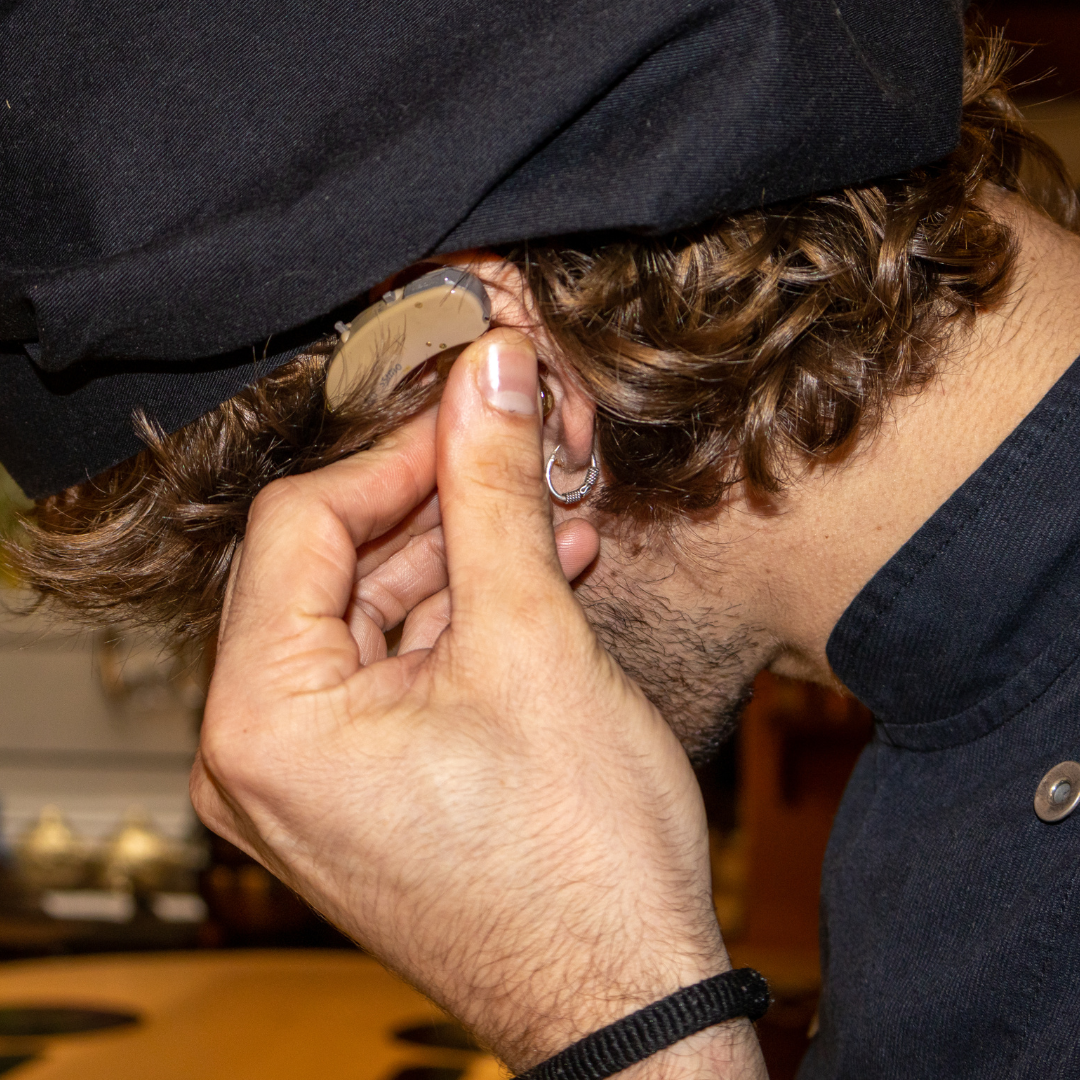
Tracking speech in busy dining venues can feel exhausting when environmental noise drowns out your hearing. We perform comprehensive diagnostic assessments to evaluate hearing in quiet rooms and challenging acoustic spaces to identify functional deficits. After diagnosing the source of your difficult hearing, we design targeted interventions tailored to your listening needs.
Why Do I Hear Well in Quiet but Struggle in Restaurants?
Quiet rooms provide a favorable signal-to-noise ratio, meaning a speaker’s voice is much clearer than the sounds around it. Commercial restaurant spaces present the polar opposite acoustic dynamic. Competing conversations, background music, tableware clatter, and acoustic reflections clash with incoming speech, making auditory processing exceptionally strenuous.
This symptom pattern often reflects underlying high-frequency hearing loss, central processing dysfunction, or physiological aging of the auditory nerve. Cognitive exhaustion, physical fatigue, low ambient lighting, and increased distance from your conversational partner further compound the challenge. Certain patients demonstrate normal sensitivity on routine audiograms while struggling significantly during advanced speech-in-noise testing. Experiencing speech-recognition struggles in noisy dining venues warrants a formal audiological evaluation regardless of seemingly normal quiet hearing.
Diagnosing High-Frequency Hearing Loss and Clarity Issues
We begin by reviewing your history of communication difficulties, prior noise exposures, ringing or tinnitus, pharmaceuticals, and unilateral symptoms.
Standard pure-tone audiometry gauges the lowest volume thresholds detectable across varying acoustic frequencies via specialized earphones and bone oscillators. In high-frequency hearing loss, the audiogram reveals a sloping configuration where hearing acuity drops progressively as pitch frequencies increase. Comprehensive evaluations frequently include impedance tympanometry to examine middle-ear function and recorded word-recognition testing to measure speech understanding.
Standard quiet test booths fail to simulate real-world restaurant noise, making speech-in-noise testing a crucial clinical tool. This procedure gauges speech-discrimination accuracy while competing multi-source noise becomes incrementally louder. In combination, these diagnostic metrics reveal whether communication hurdles involve audibility thresholds, speech discrimination, neural noise management, or mixed conditions.
Auditory Processing Disorders: Impact on Adult Communication
Auditory processing disorders interfere with the brain’s ability to process and decipher acoustic signals arriving from the ears. While peripheral ears may register soft tones normally, the auditory cortex struggles to filter competing noise, resolve phonetic contrasts, or keep pace with rapid conversation. Our clinical team starts by examining peripheral auditory thresholds, subsequently deciding if an auditory-processing test battery or multidisciplinary consultation is necessary.
Actionable Listening Tips for Noisy Social Settings
Simple situational adjustments enhance the speech signal entering your ears and offer clearer facial cues. Before heading out to eat, select dining spots with quieter acoustic profiles or dine during low-volume hours. Facilities equipped with upholstered booths, acoustic baffles, fabric curtains, carpeted floors, and soft materials prove far easier on hearing than minimalist, hard-tiled spaces.
In-venue communication guidelines:
- Ask for seating positioned far away from open kitchens, noisy bar areas, ceiling speakers, and large parties.
- Sit with your back near a wall to reduce noise coming from behind you.
- Seat yourself facing conversation partners under clear, bright lighting to facilitate visual speechreading.
- Maintain the shortest comfortable physical distance between yourself and your conversation partner.
- Place your better-hearing ear toward the person you most want to hear.
- Request that companions rephrase misunderstandings using different words rather than repeating the same sentence.
- Validate significant pieces of information directly rather than feigning understanding during dialogue.
- Take a brief listening break when fatigue begins to build.
- Ask dinner guests to speak with clear enunciation at a steady, natural conversational rate.
- Shouting can distort speech and does not necessarily make words easier to understand.
Assistive Hearing Tools and Technology for Complex Acoustic Environments
Optimal technological solutions depend entirely on the etiology of your symptoms, target acoustic spaces, and whether measurable hearing loss exists. Prescription hearing aids fitted by an audiologist leverage directional microphone arrays, advanced digital noise reduction, and dedicated restaurant programs to focus on frontal speech while dampening background sound. Patients must uphold realistic expectations because modern amplification cannot strip out every ambient human voice completely.
Pairing your devices with a remote wireless microphone generates a substantial improvement in the direct signal-to-noise ratio. Positioned near or clipped to the speaker, the device transmits raw speech audio directly to paired hearing aids or external listening receivers. This wireless transmission substantially diminishes the acoustic degradation caused by physical distance and ambient room noise.
Other useful options include:
- Table microphones for small-group conversations
- Hearing-loop telecoils that stream clean audio in loop-equipped establishments
- Smartphone speech-to-text or live-captioning applications
- Advanced hearables incorporating assistive directional listening programs
- Decibel-monitoring apps and crowd-sourced dining platforms that track restaurant noise
We can compare options, confirm compatibility, and teach you how to use the selected device.
The Clinical Role of Audiologists in Managing Loud Environments
A professional clinical assessment moves beyond basic baseline statements like “I hear fine in quiet rooms.” Our audiology team assesses the unique environments, speaking partners, and ambient noise profiles that challenge you to choose targeted diagnostic tools. Your comprehensive workup may involve pure-tone hearing thresholds, middle-ear testing, recorded word recognition, and speech-in-noise measures. Central auditory-processing testing is considered whenever clinical intake and initial test outcomes point toward higher-order deficits.
Sudden unilateral hearing drops, acute asymmetric changes, or rapid auditory decline mandate evaluation by an ear, nose, and throat physician. Tailored audiological treatment identifies the exact origin of listening breakdown rather than assuming environmental dining noise is the sole culprit.
Schedule a Hearing Evaluation Today
If noisy restaurant gatherings leave you struggling to follow dialogue, pulling away, or feeling completely drained, schedule an audiological evaluation with our team. We provide proven treatments to enhance your hearing in noisy environments, offering hearing aid fine-tuning, specialized assistive accessories, and individualized auditory therapy.
Get in touch with our team to request an appointment and rediscover confident, stress-free restaurant conversations.